| << zur Fortran-Startseite | |
| < japi | BLAS und ATLAS > |
Allgemeines
Auch pilib ist ein Open-Source-Ansatz für die Erstellung von GUIs mittels Fortran. Anders als japi verwendet pilib zu diesem Zweck die GTK+-Bibliothek. Momentan befindet sich dieses Projekt in einer frühen Entwicklungsphase (Alpha-Status, Stand: Anfang 2006).
Für nähere Informationen hinsichtlich der GTK+-Bibliothek wird auf die GTK+-Homepage verwiesen.
pilib-Installation
- Download des pilib-Softwarepakets von der im Abschnitt Weblinks angegebenen pilib-Internetadresse.
- Entpacken (gunzip, tar).
- Installation der Bibliotheksbestandteile für Linux mit dem üblichen ./configure, make, make install.
Für eine detailliertere Installationsanleitung wird auf die im Softwarepaket enthaltene INSTALL- und README-Datei, sowie das pilib-Manual im HTML-Format verwiesen.
Beispiel
| Fortran 90/95-Code (free source form) |
module bspmod
  implicit none
  save

  integer :: myedit1, myedit2, myedit3
end module bspmod


program bsp
  use pimod
  use bspmod
  implicit none

  integer :: mywin, mycontainer, mybutton, mytext, myclose, myclick

  call piinit

  call gkwindow(c("Addition"), 1, 0, mywin, myclose)

  ! Container (in diesem Fall eine Table)
  call gkcontain(3, 2, 4, 5, mycontainer)
  call gkput(0, 0, -1, -1, mywin, mycontainer)

  ! Label
  call gktext(c("Zahl 1: "), mytext)
  call gkputtable(0, 0, 0, 0, 4, 4, 5, 5, -1, -1, mycontainer, mytext)

  ! Einzeiliges Eingabefeld mit einer Breite von 10 Zeichen
  call gkxedt(10, myedit1)
  call gkputtable(1, 0, 1, 0, 4, 4, 5, 5, -1, -1, mycontainer, myedit1)

  ! Label
  call gktext(c("+"), mytext)
  call gkputtable(0, 1, 1, 1, 4, 4, 5, 5, -1, -1, mycontainer, mytext)

  ! Label
  call gktext(c("Zahl 2: "), mytext)
  call gkputtable(0, 2, 0, 2, 4, 4, 5, 5, -1, -1, mycontainer, mytext)

  ! Einzeiliges Eingabefeld mit einer Breite von 10 Zeichen
  call gkxedt(10, myedit2)
  call gkputtable(1, 2, 1, 2, 4, 4, 5, 5, -1, -1, mycontainer, myedit2)

  ! Schaltfläche
  call gkbutton(c("="), mybutton, myclick)
  call gkputtable(0, 3, 2, 3, 4, 4, 5, 5, -1, -1, mycontainer, mybutton)

  ! Label
  call gktext(c("Ergebnis: "), mytext)
  call gkputtable(0, 4, 0, 4, 4, 4, 5, 5, -1, -1, mycontainer, mytext)

  !  Einzeiliges Eingabefeld mit einer Breite von 10 Zeichen
  call gkxedt(10, myedit3)
  call gkputtable(1, 4, 1, 4, 4, 4, 5, 5, -1, -1, mycontainer, myedit3)

  call gkshow(mywin)

  do while(myclose == 0)
    call gkproc

    if(myclick /= 0) then
      call calculate
      myclick = 0
    end if
  end do

  call gkdestroy(mywin)
end program bsp


subroutine calculate
  use pimod
  use bspmod
  implicit none

  real          :: k1, k2, string2real
  character(30) :: cstr

  k1 = string2real(myedit1)
  k2 = string2real(myedit2)

  write(cstr, *) k1+k2

  call gksetstring (c(cstr), myedit3)
end subroutine calculate


function string2real(widget)
  use pimod
  implicit none

  real                :: string2real, zahl
  integer, intent(in) :: widget
  character(30)       :: cstr
  type(string)        :: str

  call gkgetstring(str, widget)
  cstr = f_str2char(str)
  read(cstr, *) zahl   ! Umwandlung eines character-Wertes in eine real-Zahl
                       ! unter Zuhilfenahme des internal-file-Mechanismus
  string2real = zahl
end function string2real
|
Kompilieren, Linken:
g95 bsp.f95 -lpilib -lpilibf -I/usr/local/include
Bei der pilib-Installation werden mod-Dateien in ein Standard-Include-Verzeichnis geschrieben. Der Optionsschalter "-I" weist den Compiler an, im gegebenem Verzeichnis nach Include-Dateien zu suchen, in diesem Fall nach mod-Dateien. Das Format der mod-Dateien ist compilerabhängig.
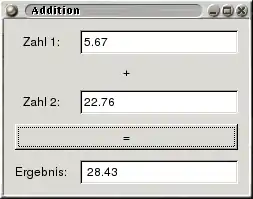
Dieses Beispiel soll nur einen ersten Eindruck von pilib geben. Eine genauere Beschreibung der verwendeten pilib-Unterprogramme und Subroutinenparameter, sowie eine Auflistung weiterer Möglichkeiten der pilib-Bibliothek wird hier mit Hinweis auf die dem pilib-Softwarepaket beiliegenden Dokumentationsdateien nicht getätigt.
Weblinks
| << zur Fortran-Startseite | |
| < japi | BLAS und ATLAS > |